
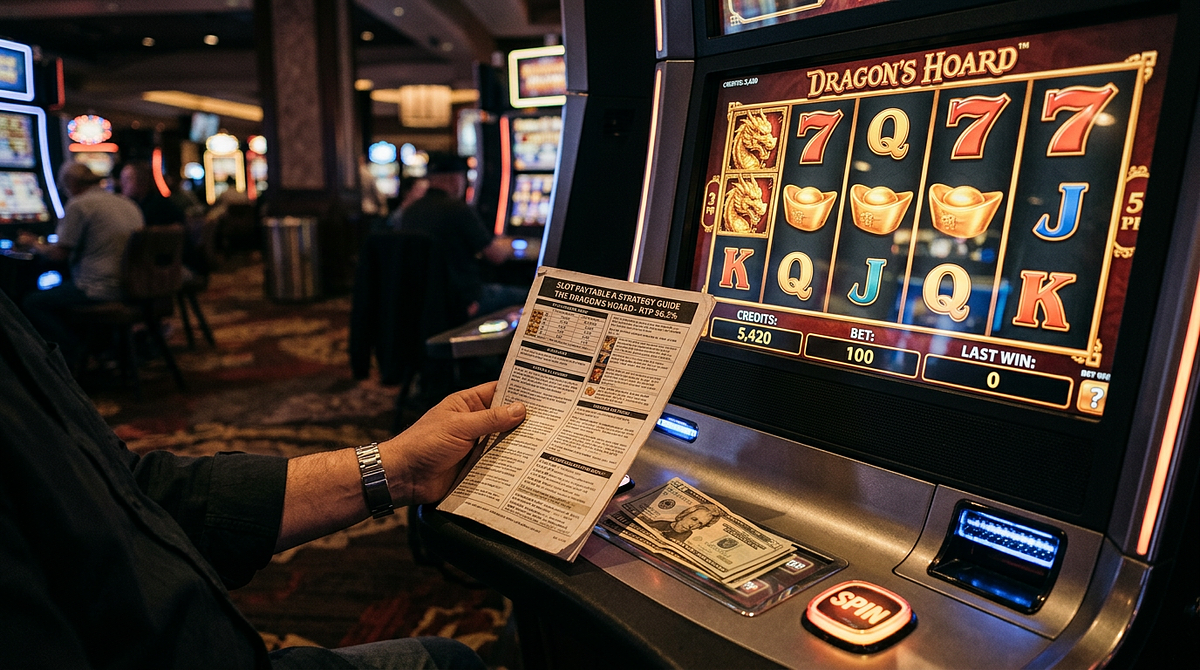
Advantage play in slots means using specific techniques and situational awareness to improve your expected outcomes beyond what standard play offers. This page covers the key areas where players undermine their own edge, including bankroll management, volatility, paytable reading, rewards programs, and loss-chasing behavior. By the end, you’ll have a clear picture of what separates disciplined advantage play from the habits that work against it.
Defining Advantage Play in the Slot Context
Advantage play in slots means deliberately identifying situations, game states, or operator conditions that give the player a measurable edge. It’s different from blackjack, where card counting changes expected value through ongoing decisions, or video poker, where choosing the right pay table and playing optimal strategy can produce a long-term positive return. Slot advantage play doesn’t come from in-game skill. The reels run on a random number generator, and nothing you do changes the outcome of any individual spin. The edge, when it exists, comes from conditions surrounding the machine, not from how you spin it.
How Advantage Play Differs From Standard Slot Play
Standard slot play accepts the house edge as a fixed cost. You pick a machine, set a bankroll, and ride the variance without expecting the math to shift. Advantage play works from a different starting point: it looks for conditions where expected value temporarily moves in your favor. Those conditions include progressive jackpots that have grown large enough to push expected return above 100%, banked-state machines that hold partial progress toward a bonus, promotional offers that cover part of your wagering cost, and rewards programs where cashback or loyalty credits offset your theoretical loss.
Most slot sessions won’t offer any of these conditions. For the typical player, “advantage play” is really closer to disciplined loss-minimization, controlling bet size, session length, and machine selection, than to finding a genuine positive expected value situation.
Why Player Behavior Determines Whether Any Edge Survives
Spotting an advantageous condition is only the first step. Even when a progressive has crossed its breakeven point or a promotion has shifted the math in your favor, common behavioral and informational mistakes can wipe out that edge before you realize it. Misreading pay tables, betting too much relative to your bankroll, chasing losses when variance turns against you, and wasting time on low-yield bonus farming all cancel out whatever theoretical advantage you had. These mistakes are what separate disciplined play from undisciplined play. The list below covers the recurring errors that consistently undermine advantage play in slots.
Seven Mistakes That Undermine Advantage Play in Slots
The items below cover the player errors most commonly seen in slot sessions that prevent any edge, whether situational, promotional, or behavioral, from producing real results. They’re not ranked by severity. Each one is a specific behavior you can fix on its own, without needing to address the others first. Fix one and you keep that benefit regardless of what else you’re still working on. Here are the seven.
1. Playing Without a Defined Bankroll Limit
Walking into a session without a fixed spending ceiling removes the one control variable you actually own. A session bankroll is a hard stop, a dollar amount you’re willing to lose before the first spin, set in advance and independent of how the session goes. This is separate from your bet size, which controls how much you risk per spin. The bankroll controls your total exposure for the session. Without a limit, you play until the money runs out, meaning the session ends by depletion, not by choice. For a structured approach to setting these numbers, see this rules-based guide to casino bankroll management for slot players. The fix is simple: set the bankroll before you spin and treat it as non-negotiable, no matter what happens.
2. Ignoring Game Volatility When Selecting Titles and Bet Sizes
Volatility, also called variance, describes how a slot distributes its payouts. High-volatility games pay out less often but in bigger amounts. Low-volatility games pay more frequently but in smaller amounts. High-volatility games require a larger bankroll relative to your bet size to survive the long dry stretches between meaningful wins. Low-volatility games let you play longer but cap your upside. The mistake is sizing your bets around the win you want rather than around the game’s variance and your available bankroll. If you want a deeper breakdown of how these tiers work in practice, the guide on what slot volatility means across low, medium, and high variance levels covers the full picture. The fix is to match your bet size to the game’s volatility and what you have to work with, not to the outcome you’re hoping for.
3. Skipping the Paytable and Game Rules Before Play
Paytables tell you hit frequencies, symbol values, bonus trigger conditions, and, in some games, whether you need to bet the maximum to qualify for the top prize or a progressive jackpot. Skip this step and you might be wagering at a level that can’t win the advertised top award, or missing rule conditions that significantly affect your expected return. Bonus features, multipliers, and qualifying lines often have activation requirements that aren’t visible during regular play. The fix is to read the paytable before your first spin and confirm any bet-size requirements tied to top awards or progressive prizes.
4. Not Using Available Rewards Programs or Promotional Credit
Loyalty programs, cashback offers, free spins, and matched-deposit credits are quantifiable returns that reduce the effective house edge or extend your session at no extra cost. They add value you’d otherwise leave on the table. Not enrolling in available programs, or earning credit and not using it, cuts a measurable piece out of your total session economics. The fix is to enroll in available programs and treat the promotional yield, points, cashback rates, bonus credit, as part of your session’s total expected return, not as an afterthought.
5. Misreading or Ignoring the Return-to-Player Figure
The return-to-player (RTP) figure is a long-run statistical average calculated across millions of spins. It’s not a prediction of what will happen in your session. Two opposite mistakes come up here: some players overweight RTP and expect their short-term results to track the published number, while others ignore it entirely and treat all games as equivalent. Both distort game selection. A 96% RTP game and a 92% RTP game have meaningfully different long-run expectations, but neither figure tells you what will happen in a single session, where variance is in charge. The fix is to use RTP as a comparison tool when choosing between games, while accepting that variance, not RTP, drives any individual session. Understanding how to read slot RTP and where to find the percentage inside a game makes this comparison much easier in practice.
6. Chasing Losses Beyond Predetermined Limits
Loss-chasing means increasing your bet size or playing longer to try to win back what you’ve lost. This makes things worse, not better, because bigger bets don’t change the house edge. They just speed up the rate at which your bankroll moves in either direction. Loss-chasing is most destructive after a losing streak, exactly when you’re least equipped to make clear decisions and most likely to rationalize abandoning your limits. The fix is to set specific loss and time limits before the session starts and treat hitting either one as an automatic session end, no exceptions.
7. Continuing to Play Through Winning Streaks Without a Stop-Win Rule
The flip side of loss-chasing is failing to lock in your gains. Slots have a negative long-run expectation, so a winning streak isn’t a trend you can ride. It’s short-term variance that will revert toward the underlying math the longer you play. Without a stop-win threshold, most of what you’ve won tends to go back to the house as the session continues. Players often justify staying at the machine after a win because they’re “playing with house money,” but that’s a framing error. Once you’ve won it, it’s your money. The fix is to set a stop-win figure alongside your loss limit and leave when you hit either one.
How the Seven Mistakes Compare on Impact and Correctability
The seven mistakes don’t all carry the same weight, and they don’t all take the same effort to fix. Some are structural decisions you make before a session starts and can correct by changing a single habit. Others are cognitive patterns in how you interpret outcomes, and those take more sustained attention to change. The table below maps each mistake against its impact on expected value, how easy it is to correct, and what you need to do to fix it.
|
Mistake |
Primary Impact on Expected Value |
Correctability |
Required Corrective Action |
|---|---|---|---|
|
Ignoring published RTP and volatility data |
High |
High |
Check the paytable and provider RTP disclosure before selecting a game. |
|
Misreading near-misses as predictive signals |
Moderate |
Moderate |
Treat each spin as an independent RNG event with no memory of prior results. |
|
Chasing losses with increased bet size |
High |
Moderate |
Set a fixed unit size at session start and don’t increase it mid-session. |
|
Accepting bonuses without reading wagering terms |
High |
High |
Calculate the effective playthrough cost before opting in to any promotion. |
|
Playing without a defined bankroll or stop-loss |
High |
High |
Define session bankroll, loss limit, and walk-away threshold in advance. |
|
Confusing hit frequency with profitability |
Moderate |
Moderate |
Evaluate games on RTP and variance combined, not on frequency of small wins. |
|
Overestimating the impact of timing or “hot” machines |
Low |
High |
Discard timing-based heuristics; rely on documented game mathematics. |
Realistic Boundaries of Advantage Play in Slots
Slot machines are built around a fixed house edge encoded in the game’s RTP, and that math doesn’t bend to skill, timing, or pattern recognition during ordinary play. Genuine positive-expectation situations do exist, but they’re narrow and depend on specific game-state conditions or promotional terms, not on technique applied to a standard spin. For most players, advantage play in practice means behavioral discipline: controlling the variables you actually govern, because the game’s math is outside your control.
Where Genuine Positive-Expectation Situations Can Arise
A small number of slot configurations can shift expected value above breakeven under specific conditions. Progressive jackpots build up a portion of every wager into the prize pool, and once that pool grows past a calculable breakeven point relative to the base game’s return, each spin carries positive expectation until the jackpot is won. Must-hit-by jackpots, which are guaranteed to trigger before a stated ceiling, compress that math further as the meter approaches the cap.
Banked-state and accumulator games store partial progress toward a bonus, so a machine left mid-accumulation by a previous player can offer favorable expectation to whoever completes it. Promotional overlays, cashback, bonus credits, or free-spin terms whose value exceeds the wagering cost, represent a fourth category. Finding these conditions requires sustained observation, mathematical literacy, and physical or account access that most casual players won’t have.
The Discipline-Centered Interpretation of Edge
For the recreational player, the achievable edge isn’t against the game’s math. It’s against your own behavioral tendencies. Correcting the seven mistakes outlined above doesn’t turn a negative-expectation game into a positive one. The house edge is still there on every spin, no matter how disciplined you are. What discipline does change is how fast your bankroll depletes, how much variance you’re exposed to, and how much entertainment value you get per dollar wagered. That’s the practical definition of advantage play for most players: managing the inputs you control rather than trying to beat fixed odds.
Applying These Findings to Your Next Slot Session
Genuine positive-expectation situations in slots are narrow and conditional. For the typical player, the real edge comes from eliminating the seven behavioral mistakes covered above. Use the comparison table as a starting point and tackle the highest-impact, easiest-to-fix mistakes first. Before your next session, set a bankroll, a stop-loss, and a stop-win threshold. That’s the minimum baseline for playing with any discipline at all.
Frequently Asked Questions
What does advantage play mean in slots?
Advantage play means using techniques or situational awareness to shift expected value in your favor. In slots, that’s a narrower concept than in skill-based casino games where your decisions directly affect the house edge. For most recreational players, it means the discipline-centered version: bankroll control, game selection, and capturing rewards, rather than the rarer case of a true positive-expectation situation.
Can you really get an edge on a slot machine?
Genuine positive-expectation situations do exist in the categories already described, progressive jackpot thresholds and promotional overlays, but they’re uncommon and depend on access, timing, and specific qualifying conditions. Most players will rarely encounter them, which is why the discipline-based version of advantage play is the more practical framework to work from.
What is the biggest mistake slot players make?
Bankroll-related errors rank highest on both impact and correctability in the comparison table. Specifically, going in without a defined session limit and then chasing losses when things go wrong. They’re the most consequential category to fix because the corrective behavior, setting and enforcing a numeric limit before you start playing, requires no technical knowledge at all.
Does reading the paytable actually change outcomes?
The paytable doesn’t change the underlying probability distribution of the game. That’s fixed by the random number generator. What it does change is your bet-sizing and game-selection decisions, including the qualifying bet level required to access the top prize. Those decisions directly affect your realized return.
How is RTP different from advantage play?
RTP is a fixed long-run statistical property of the game, typically expressed as a percentage averaged over millions of spins, and it doesn’t change based on how you play. Advantage play looks for conditions, promotional overlays, jackpot thresholds, or rewards offsets, where the situational expected value diverges from that baseline RTP in your favor.
Are rewards programs a form of advantage play?
Signing up for a rewards program is one of the simplest ways to shrink the house edge. It converts a percentage of your theoretical losses into cashback, free play, or comps without changing anything about how you play. That makes it genuinely accessible advantage play, not just a perk. If you haven’t signed up yet, finding the best-value casino rewards program in your area is a worthwhile next step.