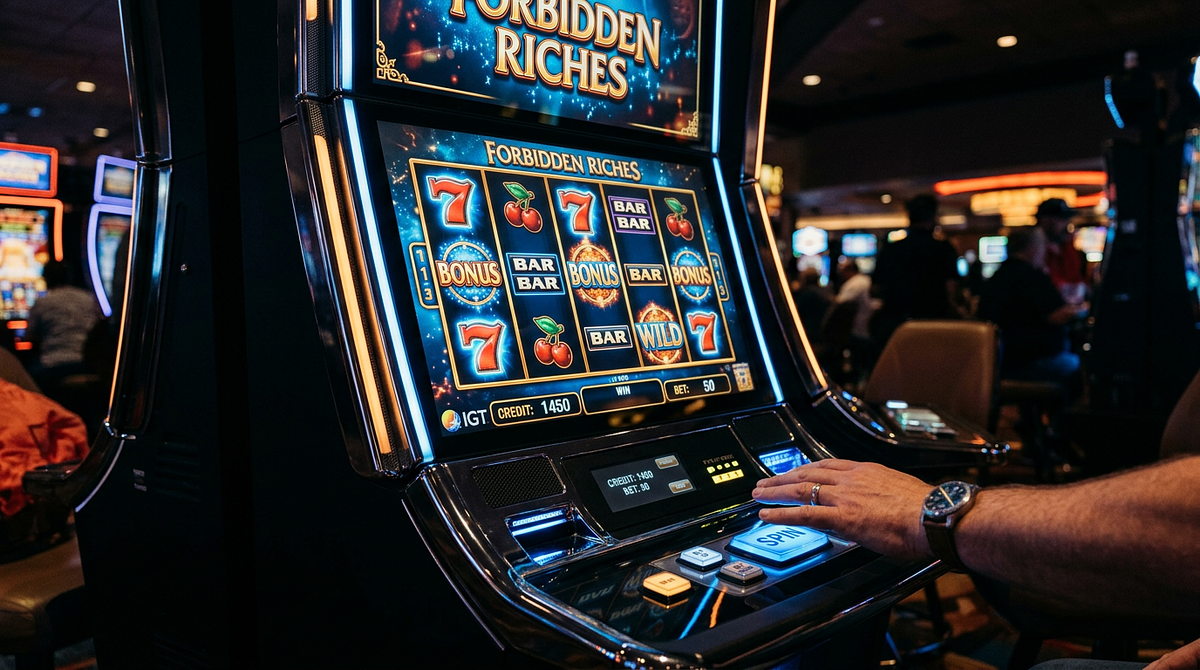
Slot machine strategy is a real topic, but it works within a fixed boundary: every spin is decided by a random number generator, which means the math of the game can’t be changed by how you play. This page covers what’s actually within your control, including bet sizing, bankroll management, and game selection, along with common approaches that have no effect on results. By the end, you’ll have a clear picture of what slot strategy can and can’t do, so you can make smarter decisions about how you play.
How Slot Machines Actually Work
Every spin on a modern slot machine is produced by a random number generator (RNG), a software process that cycles through values continuously and independently of anything you do. When you trigger a spin, the RNG’s current value gets mapped to a reel outcome. The machine’s long-term payout is fixed by its underlying math model, programmed by the developer and certified before release. These two things, instant randomness on every spin and a fixed long-term distribution, are the technical foundation against which any strategy claim has to be measured.
Independence of Spins and the Gambler’s Fallacy
Each spin is statistically independent. The RNG has no memory of prior outcomes, and the probability of any result on the next spin is the same regardless of what came before. This is why the gambler’s fallacy doesn’t hold up: the idea that a machine is “due” for a win after a losing streak, or that a “hot” machine will keep paying, has no basis in how the machine actually works.
Take a slot with a 1-in-100 chance of triggering a bonus. After 200 spins without a bonus, the probability on spin 201 is still 1 in 100, not higher, not lower. The machine has no way to track or compensate for a dry streak. That single fact rules out every strategy built on the idea that past spin patterns predict future outcomes.
What This Means for Strategy Claims
Any strategy that claims to predict, time, or influence the result of a single spin doesn’t match how the machine works. That includes systems based on spin counting, hot/cold machine detection, button-press timing, stop-spin techniques, or progressive bet sequences designed to “catch” a payout. None of these can change an RNG output that’s determined independently of what you do.
There is a separate category of decisions that you do control: which game you pick, how much you bet per spin, and how long you play. These choices don’t change the probability of any single spin, but they shape the conditions of play, the variables that affect your exposure, session length, and expected cost. That distinction between outcome (fixed) and conditions (player-controlled) is the framework used to assess every strategy claim in the sections below.
Common Slot Strategy Myths
Several widely circulated slot strategies directly contradict the independence-of-spins principle covered above. They stick around not because they produce results, but because people remember the wins and forget the losses. That’s a textbook confirmation bias loop, and it gets reinforced by forum posts, video clips, and listicle content. The categories below cover both mechanical misconceptions (claims about how the machine behaves) and behavioral misconceptions (claims about how your actions influence outcomes).
Strategies That Do Not Work
The following claims aren’t supported by how slot machines actually work. Each spin is generated by an independent RNG call with no memory of prior results.
Hot and cold machines: A machine that paid out recently is no more or less likely to pay out on the next spin. The RNG doesn’t track payout history.
Time of day or day of week: Outcome probabilities are the same at 3 a.m. on a Tuesday and 9 p.m. on a Saturday. The RNG runs continuously and produces results with no reference to the clock or calendar.
Stop button or rhythm-based reel control: Pressing stop, timing your spin, or developing a pressing rhythm can’t change the outcome. The RNG has already selected the result before the reel animation even starts.
Increasing bets after losses to “recover”: Doubling or escalating your bets after a losing streak doesn’t improve your odds on the next spin. Each spin resets independently, and bigger bets just increase your exposure rather than correct prior losses.
Patterns based on prior payouts: Sequences of past results, near-misses, repeated symbols, or apparent streaks carry no predictive value. The RNG produces each outcome without any reference to previous spins.
Return to Player (RTP) as a Selection Metric
Return to Player (RTP) is the theoretical percentage of total wagered money a slot returns to players, calculated over a very large number of spins and expressed as a percentage. A slot advertised at 96% RTP is mathematically designed to return €96 for every €100 wagered across millions of spins. RTP is the most useful pre-play metric you have for comparing machines, because it tells you the built-in mathematical edge before any spin happens.
Typical RTP Ranges and How to Compare Machines
Commercial slot machines commonly publish RTP figures somewhere between 88% and 98%. Online slots tend toward the higher end of that range, while land-based machines often sit lower, reflecting different operating costs and regulatory environments.
A machine with a 97% RTP returns more to players on average than one at 92%, but that difference only shows up across a very large number of spins. RTP doesn’t predict what will happen in any individual session, hour, or day of play. A high-RTP machine can produce long losing stretches, and a low-RTP machine can produce a single large win.
To find the RTP for a specific machine, check the in-game information panel (usually accessed through a help or “i” icon), the operator’s published game data on the title’s listing page, or the documentation released by the studio that made the slot. For a deeper breakdown of what the percentage actually means and how to locate it, see this guide on how to read slot RTP figures and where to find them.
The Limits of RTP as a Decision Input
RTP is a long-run statistical expectation, not a session-level predictor. The figure only converges over sample sizes far larger than most recreational players will ever produce in a lifetime of play, which means short-session results can swing sharply from the published percentage in either direction.
RTP also says nothing about how returns are distributed. Two machines with identical 96% RTPs can deliver very different playing experiences depending on volatility, which governs the size and frequency of payouts. That’s covered in the next section.
Small RTP differences, say 95.5% versus 96.2%, have negligible practical effect over a short session. Articles that frame RTP as a reliable predictor of individual outcomes are overstating what the metric can do.
Volatility and Bet Sizing
Volatility, sometimes called variance, describes how a slot distributes its wins over time. Low-volatility machines pay smaller amounts more often. High-volatility machines pay larger amounts less often. The total expected return across a long sample can be identical between the two; what changes is the shape of the outcome distribution. Together, volatility and per-spin bet size determine how quickly your bankroll gets used up and what kind of session you’ll actually experience.
Matching Volatility to Session Goals
You can match your machine choice to the type of session you want. Low-volatility machines suit players who want longer playtime and a steady stream of small returns, since wins arrive often enough to slow bankroll depletion under normal conditions. High-volatility machines suit players willing to absorb extended losing stretches in exchange for the chance of larger payouts when wins do land. Neither type offers a higher expected return than the other. The choice shapes the texture of the experience, not the underlying math. For a full breakdown of how the three volatility levels differ in practice, the guide on what slot volatility means across low, medium, and high variance games covers each level in detail. The following criteria help identify where a specific machine sits on the volatility scale:
Published volatility or variance rating from the game studio, usually shown on the game information screen.
Paytable structure, particularly the gap between the lowest and highest symbol payouts.
Maximum win multiplier expressed as a multiple of the bet.
Frequency and trigger rate of bonus features such as free spins or pick rounds.
Bet Sizing Relative to Bankroll
Per-spin bet size interacts directly with volatility to determine session length. A higher bet on a high-volatility machine burns through your bankroll faster because losing streaks are longer and deeper, and a fixed bankroll absorbs fewer spins before it’s gone. A smaller bet extends the number of spins available and gives the distribution more chances to produce a win. A commonly cited rule of thumb for moderate-volatility play is a per-spin bet of roughly 1% or less of your session bankroll, which is meant to keep your funds viable across a typical session. This is a session-management heuristic that controls exposure and pacing. It doesn’t change the house edge, the RTP, or the odds of any individual spin.
Bankroll Management
Bankroll management is the single most consequential thing a slot player actually controls. It doesn’t change the house edge, the RTP, or the random outcome of any spin. The math of the machine stays fixed no matter how you organize your funds. What it controls is exposure: how much money is at risk in a session, how long that session can last, and when you stop. To be honest about it, bankroll management isn’t a method for producing wins. It’s the operational core of any slot strategy that takes the machine’s fixed mathematical edge seriously.
Practical Bankroll Rules
The following rules give you concrete ways to limit and structure your exposure before and during a session.
Set a dedicated session bankroll: Allocate a specific amount for the session that’s separate from living funds, savings, or any money committed to other obligations.
Define a loss limit before play begins: Decide in advance the maximum amount you’re willing to lose in the session, and stop when you hit that number.
Define a win-stop threshold: Set a specific profit point at which the session ends, so you’re not making that call in the heat of the moment.
Size per-spin bets as a small fraction of the bankroll: Keep each wager to a low percentage of your session bankroll so that variance doesn’t wipe out your funds in a short run of bad spins.
Treat winnings as part of the session result: Count any accumulated winnings as your own money rather than “house money,” since treating winnings as expendable encourages giving back gains that would otherwise close the session in profit.
What Bankroll Management Cannot Do
Bankroll management extends play time and caps losses, but it doesn’t change the mathematical expectation of a slot machine. The house edge is built into the game’s RTP and applies to every spin regardless of how you organize your funds. Disciplined bankroll rules don’t turn a negative-expectation game into a positive one, and they don’t increase your chances of a winning session. Content that frames discipline as a route to winning misrepresents the mechanics. The expected value of slot play stays negative whether your bankroll is managed tightly or carelessly. If you want a structured framework with specific numbers and percentages, the rules-based guide to casino bankroll management for slot players covers session sizing, bet fractions, and fund allocation in detail.
What Players Can and Cannot Control
The previous sections covered RNG mechanics, RTP, volatility, and bankroll rules as separate topics. This section pulls them together into a single framework that separates the levers you actually control from the variables fixed by the machine. That distinction matters because most slot strategy claims fail right at this boundary. They assign control to factors that are mathematically out of your reach, or they ignore the factors that genuinely fall within it.
Controllable vs. Non-Controllable Factors
The table below pulls the article’s framework into a single comparative view.
Factor
Player Control
Effect on Outcome
Machine selection (RTP)
Controllable
Influences long-run average return
Volatility choice
Controllable
Shapes payout distribution and session feel
Bet size
Controllable
Determines bankroll burn rate and exposure
Session length and loss limits
Controllable
Caps losses and defines stop points
Outcome of any individual spin
Not controllable
Determined by RNG, independent of prior spins
Long-run expected value
Not controllable
Fixed by the machine’s programmed math model
Applying a Realistic Slot Strategy
A defensible slot strategy acts only on conditions of play: machine selection by RTP and volatility, bet sizing relative to bankroll, and a pre-set loss limit. Outcomes are governed by the RNG and can’t be influenced. Use the controllable-versus-non-controllable framework from the table above as your decision tool, and start your next session by checking the machine’s RTP and setting a loss limit before the first spin.
Frequently Asked Questions
Is there a real strategy to win at slot machines?
No strategy can change the mathematical edge built into a slot’s RNG, since outcome-based claims fall outside what you control. What remains are condition-of-play decisions: game selection by RTP, volatility matching, bet sizing, and bankroll limits. These shape the session but don’t change expected value.
Does the time of day or day of the week affect slot payouts?
Timing has no effect on outcomes. Each spin is an independent event resolved by the RNG with no reference to the clock, the calendar, or prior results. Claims that certain hours or days pay more often fall into the same category as the other timing-based myths covered earlier.
How do I find a slot machine’s RTP?
The figure is published in the game’s information or help panel, and is often duplicated on the operator’s game data pages or in the studio’s official documentation. Cross-checking these sources is the verification step covered in the RTP section.
Should I increase my bet after a losing streak?
Raising bets after losses assumes past spins influence future ones, which contradicts the independence-of-spins principle and is the gambler’s fallacy in practice. The practical effect is a higher burn rate on your bankroll, accelerating depletion rather than recovering prior losses.
Is high-volatility or low-volatility better?
Neither is better in expected value terms. Volatility describes the distribution of outcomes around the same long-run return, not the return itself. The right choice depends on your session goal: longer play time at smaller variance, or fewer but larger hits. That’s covered in the volatility section.
Can bankroll management make me profitable at slots?
Bankroll management shapes how you lose, not whether you lose. Slots carry a built-in negative expected value that no betting strategy can overcome. Think of it as a discipline tool that keeps sessions controlled and losses predictable, which is genuinely useful if you’re playing for entertainment rather than profit. If you want to put that discipline to work, browsing slots by RTP is a smart place to start.