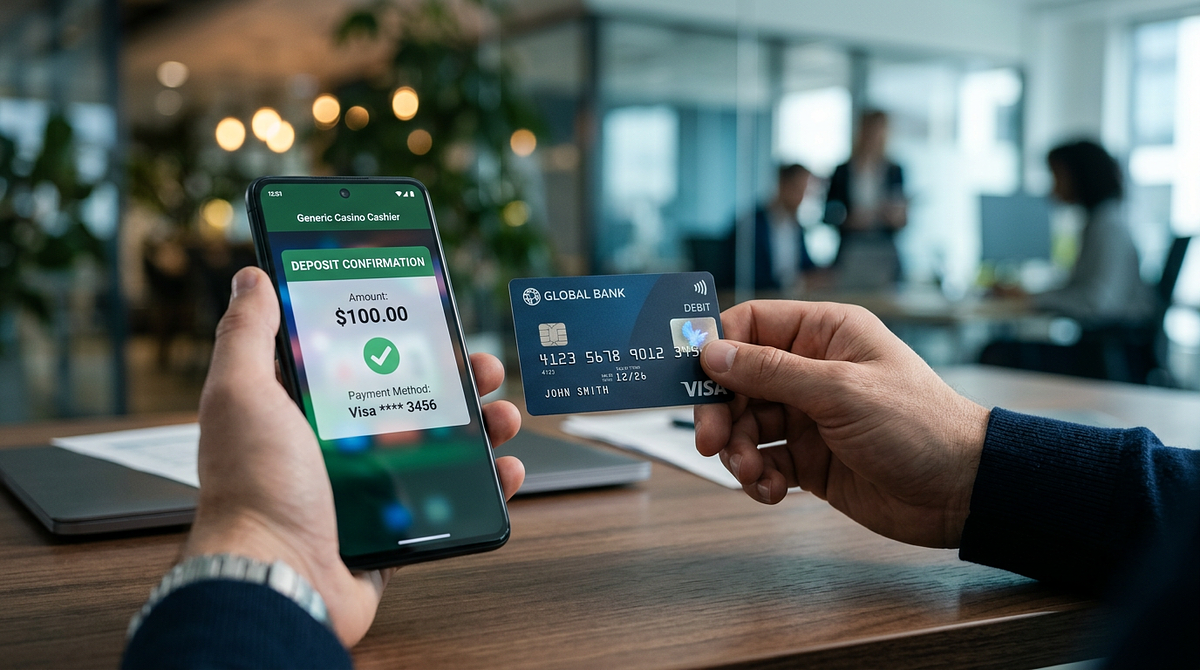
Legal US online casinos offer six main types of payment methods: debit and credit cards, digital wallets, ACH and bank transfers, prepaid options, cash-based deposits, and cryptocurrency. This guide covers how each one works for deposits and withdrawals at regulated US casinos. Every method is evaluated on four things: processing speed, fees, licensing status, and availability. By the end, you’ll have what you need to pick the method that works best for you.
How Online Casino Payment Methods Are Evaluated
Every payment method in this article is measured against four things. First is processing speed, split into deposit speed and withdrawal speed, because the two almost never match. Second is fees, both what the player pays directly and what the operator absorbs, since those costs affect availability and minimums. Third is the regulatory and licensing status of the payment provider itself, which is a trust signal separate from the casino’s own license. Fourth is availability at legal, regulated US online casinos, which changes a lot depending on the state and the operator’s banking relationships. Deposit and withdrawal performance are reported separately for each method, not averaged together.
Why Withdrawal Speed Diverges from Deposit Speed
Deposits move fast because the operator wants to get money into your account so you can start playing. Withdrawals work the other way. Before the payment rail even gets involved, the operator runs an internal review window where you can still cancel the cashout. Then come anti-fraud checks, source-of-funds reviews, and identity verification under know-your-customer rules, especially on your first withdrawal or after a big win. The payment rails themselves are also one-sided: a card network can authorize an incoming charge in seconds but may take days to push money back to your bank. When you’re estimating how long a withdrawal will take, treat the operator’s internal review window as a separate variable from the payment method’s own settlement time.
Regulatory Status as a Trust Signal
A licensed money transmitter is a company that’s authorized to move funds on behalf of others, under the supervision of a financial regulator. That regulator sets capital requirements, audit obligations, and consumer protection standards. When you fund a casino account, your money usually passes through one or more of these intermediaries before reaching the operator, and the same chain runs in reverse when you withdraw. There are three types of oversight worth knowing: federal banking regulators that supervise chartered banks and certain payment institutions, state-level money transmitter licensing that each US state runs separately, and card network compliance rules that bind issuers, acquirers, and processors to common standards. A payment provider that operates outside these frameworks carries meaningfully higher risk while your money is in transit. Understanding what a licensed online casino means and how to verify it is a useful complement to evaluating the payment providers behind it.
Card-Based Payment Methods
The card category at US online casinos covers three instruments: debit cards, credit cards, and branded prepaid cards issued on major card networks. They all run on the same underlying rail, but they differ a lot in availability, how the issuing bank treats them, and the regulatory position of the bank behind them. The big thing to know about this category is that deposits are widely supported and typically settle in seconds, while withdrawals back to a card are inconsistent, often unavailable, and depend on whether the operator has turned on push-to-card payouts. If you fund your account with a card, plan on needing a separate withdrawal method.
Debit Card Deposits and Withdrawals
Debit cards are the most widely accepted card type at regulated US online casinos. Deposits usually post to your casino balance instantly once the issuer approves the transaction. Most operators don’t charge a player-facing fee for debit deposits, though some do apply surcharges on smaller deposit amounts or repeated same-day transactions.
The biggest friction point is issuer-side declines. Some banks flag gambling-related transactions as high-risk and block them at the network level, even if the casino is fully legal in your state and you have plenty of money in your account. Withdrawal support exists at some operators through push-to-card rails, which send funds back to the same debit card you used to deposit. Settlement windows on those payouts are different from deposit timing and can range from a few minutes to several business days depending on your bank.
Before using a debit card, check the following at the specific operator:
Deposit fee policy: find out whether the operator charges a percentage or flat fee on debit funding.
Withdrawal eligibility: check whether push-to-card payouts are supported for your card network.
Issuer acceptance: confirm your bank doesn’t block gambling-coded transactions.
Settlement window: look at the published payout timing for card withdrawals, not deposits.
Transaction limits: check per-transaction and daily minimums and maximums for both deposits and withdrawals.
Credit Card Deposits
Credit card deposits are available at fewer US online casinos than debit deposits, and acceptance depends on both the operator and your issuing bank. Several major US card issuers either block gambling transactions outright or treat them as cash advances. A cash advance comes with its own fee, a higher interest rate that starts accruing immediately, and no grace period. That treatment is set by your bank, not the casino, so two players at the same site using cards from different banks can end up with very different costs.
Withdrawals back to a credit card aren’t supported, because credit card rails are built for purchases and refunds, not for sending money to a credit line. That means you’ll need to set up a separate withdrawal method, such as ACH, an e-wallet, or a check, when you create your account rather than after you’ve won.
Branded Prepaid Cards
Casino-branded or operator-issued prepaid cards work as a two-way instrument tied to one specific operator. You withdraw from your casino balance onto the card, and you can reload the card back into your casino account through a linked process. Outside the casino, these cards usually run on a major network and work for retail purchases or ATM withdrawals wherever that network is accepted, subject to the issuer’s terms. Activation requires identity verification that matches your casino account, and reloads typically come with daily load caps, minimum reload amounts, and limits on how many reload transactions you can make in a given window.
Digital Wallets and E-Wallets
Digital wallets are third-party accounts that sit between your funding source (a bank account, debit card, or credit card) and the casino operator. Transactions in both directions settle through the wallet provider’s own payment rails rather than going directly through your bank or card. At regulated US online casinos, this category typically offers the fastest withdrawal times on the menu, often clearing within hours rather than business days. Wallet logos show up prominently on operator cashier pages because the intermediary layer reduces card-network friction and lets the casino push payouts through a single integrated channel.
Comparative Analysis of Major E-Wallet Categories
The table below compares the four wallet categories that appear most often in the cashiers of legal US online casinos. It covers deposit speed, withdrawal speed, fee exposure, operator coverage, and the funding source each one requires.
Wallet Type
Deposit Speed
Withdrawal Speed
Typical Fees
US Casino Availability
Funding Source Required
General-purpose wallet (PayPal-class)
Instant
Within 24 hours, often under a few hours
No fee from the casino; wallet may charge for instant transfer to bank
Wide; available at most major regulated operators
Linked bank account or debit card
Casino-specific wallet (operator-branded play account)
Instant
Instant to 24 hours within the operator’s ecosystem
Generally none
Limited to the issuing operator and its affiliated brands
Bank account, debit card, or in-person cash load
Mobile pay-service wallet (device-tied)
Instant
Not commonly supported for withdrawals
None at the casino layer
Moderate; deposit-only at most operators
Debit or credit card loaded to the device wallet
Prepaid-linked wallet (Play+ style)
Instant
Within 24 hours to the card balance; 1–3 days to bank
Possible monthly maintenance or ATM withdrawal fees
Wide; standard on most regulated US cashiers
Bank account, debit card, or cash reload
Trade-Offs of the Intermediary Model
Routing funds through a wallet adds a privacy layer: the casino sees your wallet account rather than your card number or bank credentials, which limits how much of your primary funding information the operator’s systems ever touch. Withdrawal speed improves because wallet-to-wallet settlement skips the multi-day ACH clearing window and the card-network posting delays that slow direct methods. The trade-off is that you’re managing an extra account with its own registration, identity verification, and balance. Fees can also shift from the casino side to the wallet side. Many providers charge nothing to receive funds but apply a percentage fee for instant transfers from your wallet balance to a linked bank account, and some prepaid-linked wallets carry monthly maintenance charges. Money sitting in your wallet between play sessions is outside both the casino and your bank, which is worth thinking about from a custody standpoint.
Bank Transfer and ACH Methods
Bank transfer methods move money directly between your checking account and the casino cashier, without going through a card network or a third-party wallet. This category covers three rails: standard ACH transfers, online banking integrations that run on ACH infrastructure, and traditional wire transfers. Settlement times vary more inside this category than in any other group. Instant bank transfer products clear in seconds, domestic wires can take one to two business days, and standard ACH typically takes one to three. Fee exposure also varies a lot across these options.
ACH and Instant Bank Transfer
ACH transfers move deposits and withdrawals through the Automated Clearing House network, the same system used for direct deposit and online bill payment. Standard ACH settles in one to three business days on both sides. Instant bank transfer products, offered through bank-linking services built into the casino cashier, can post deposits in seconds and speed up withdrawals to same-day or next-day timing depending on the operator. Players typically pay no fee on either option; the casino absorbs the network cost.
The first time you link your bank, you’ll go through a verification step. You either log into your bank through a secure connector inside the cashier, or you confirm two small test deposits the casino sends to your account over one to two business days. Once verified, future transactions use the saved credentials. ACH is often a good fit for larger transactions because deposit and withdrawal limits tend to be higher than card limits, and because it doesn’t carry the cash-advance fee risk that credit card funding can trigger.
Deposit or withdrawal amounts exceed typical card limits, often in the four-figure range or higher.
You want to avoid any chance of a cash-advance fee from a credit card issuer.
You plan to use the same funding source repeatedly and benefit from a saved bank link.
Withdrawal speed matters less than avoiding fees, making standard ACH acceptable.
Wire Transfers
Wire transfers are mainly used as a high-limit withdrawal option when you need to move a large balance off the casino in a single transaction. Unlike ACH, wires carry fees on both ends: the casino’s bank may charge an outgoing wire fee, and your bank typically charges an incoming wire fee that you pay directly. Domestic wires settle within one to two business days, and the funds arrive as cleared, non-reversible credits. A wire makes sense over ACH when your withdrawal amount exceeds the operator’s ACH ceiling, when your bank doesn’t support instant ACH credit, or when you want the finality and paper trail that a wire reference number provides for a large transaction.
Prepaid and Cash-Based Methods
This category covers payment options that move physical cash or prepaid value into an online casino account without requiring a linked bank account, debit card, or credit card. It includes retail-loaded prepaid vouchers bought at participating stores, cash-at-cage and cash-at-counter services that connect land-based locations to online balances, and pay-by-cash voucher products generated inside the casino app. In most cases, the flow only goes one way: cash goes into the casino account, but withdrawals back through the same channel usually aren’t available. You’ll need a separate payout method such as ACH, a check, or an e-wallet.
Retail Cash Deposit Services
Retail cash deposit services use a barcode-and-cash workflow built into the casino app. You select the retail cash option, enter the deposit amount, and the app generates a one-time barcode or voucher code that’s valid for a limited window. You take that barcode to a participating retail location, typically a convenience store, pharmacy, or grocery chain in the operator’s partner network, hand over cash at the register, and the clerk scans the code. Funds show up in your casino balance within minutes of the scan.
Service fees are usually a flat charge per deposit, with some operators or retail partners adding a small percentage on top. Per-transaction limits are common, often capped in the low hundreds of dollars, with separate daily and weekly ceilings. There’s no withdrawal path through this channel: cash deposited at retail can’t be withdrawn as cash at the same store, so payouts have to go through a different method tied to your account.
Cash at Casino Cage
The cash-at-cage model lets you walk up to the cashier cage at a land-based casino affiliated with the online operator, hand over cash, and have it credited to your online account during the same visit. The same channel usually works in reverse: you request a withdrawal in the app and pick up cash at the cage once the request is processed. The main limitation is availability, since this option requires the online operator to have a land-based partner property in your state. There are generally no fees on either side, and settlement is same-day, with deposits and approved withdrawals accessible on the spot.
Cryptocurrency Payment Methods
The cryptocurrency category covers major coins like Bitcoin, Ethereum, and Litecoin, along with dollar-pegged stablecoins like USDT and USDC. These assets move across public blockchain networks rather than through card networks or bank rails. You fund your casino account by sending coins from a personal wallet or exchange to a deposit address the operator generates. The main thing US players need to know is that crypto is widely supported at offshore online casinos but is not an accepted funding method at most state-regulated US online casinos. The two sections below address that split directly.
Crypto Availability at Regulated US Casinos
State-licensed online casinos operate under gaming regulations that govern how player funds enter and leave the platform. In most regulated states, including New Jersey, Pennsylvania, Michigan, and West Virginia, those rules require deposits and withdrawals to flow through licensed money transmitters, regulated banks, or approved payment processors with established anti-money-laundering and know-your-customer compliance frameworks.
Cryptocurrency doesn’t currently fit those requirements in most regulated states. Public blockchains aren’t licensed money transmitters, and state regulators generally haven’t approved crypto as an allowable deposit channel for licensed operators. As a result, players at sites like DraftKings Casino, BetMGM Casino, FanDuel Casino, and Caesars Palace Online Casino won’t find Bitcoin, Ethereum, or stablecoins in the cashier. Crypto remains primarily an offshore-casino payment method for US-based players.
Speed and Fee Profile of Crypto Transactions
At operators that do accept cryptocurrency, processing speed depends on the coin and current network congestion. Bitcoin deposits typically confirm within 10 to 60 minutes once the required number of block confirmations is reached. Faster networks like Litecoin, Solana, or stablecoins on Tron or Polygon can complete in a few minutes. Withdrawals, once the operator approves them, settle on-chain in a similar window.
The fee structure is different from card and bank methods. Operators that support crypto generally don’t charge deposit or withdrawal fees, but you pay the network fee, the gas or miner fee, required to broadcast the transaction. That fee varies with network demand and isn’t set by the casino.
Side-by-Side Comparison of Payment Method Categories
The table below puts all five payment method categories into one reference view. It compares each category across five things: deposit speed, withdrawal speed, typical fees charged to the player, availability at regulated US online casinos, and the type of player each method tends to fit. Read each row as a summary of one category, and scan down any column to compare categories on a specific priority.
Payment Method Category
Deposit Speed
Withdrawal Speed
Typical Player Fees
Regulated US Casino Availability
Best Suited For
Card-based methods (debit/credit)
Instant
1–3 business days
None to low; some issuers apply cash-advance fees on credit cards
Wide; debit cards accepted at most regulated US operators, credit card acceptance varies by state and issuer
Players who want a familiar deposit channel tied to an existing bank account
Digital wallets and e-wallets
Instant
Same day to 48 hours
Generally none on the casino side; wallet-to-bank transfers may incur a fee
Broad; PayPal, Venmo, and Skrill availability depends on the operator and state
Players who want fast withdrawals and a layer between their bank and the casino
Bank transfer and ACH
Instant to 1 business day
1–5 business days
Typically none; some banks charge for outbound wire transfers
Wide; offered at most regulated US operators through VIP Preferred and direct ACH
Players moving larger amounts who accept slower payouts in exchange for direct bank settlement
Prepaid and cash-based methods
Instant for prepaid cards; same-day for cash at cage (PayNearMe)
Not available for withdrawals on most prepaid products; cash at cage requires in-person pickup
Card purchase fees and activation fees apply; casino side typically free
Available at most regulated US operators, often via Play+ branded cards and PayNearMe
Players who prefer not to link a bank account or who fund play with cash
Cryptocurrency
Minutes to under an hour, depending on network confirmations
Minutes to 24 hours
Network/miner fees apply; casino fees generally none
Limited; not accepted at regulated US online casinos in licensed states, more common at offshore sites
Players outside regulated US markets who want fast withdrawals and are comfortable with price volatility
Matching a Payment Method to Player Priorities
No single payment category wins on every dimension. Card deposits are familiar but slow on withdrawals. Cryptocurrency settles fast but requires managing digital assets. Bank transfers cost little but take time. The goal isn’t to find one universally superior option. It’s to figure out which dimension matters most to you and pick accordingly.
One practical consequence of this is that the best deposit method and the best withdrawal method are often not the same. Many players fund their account through one channel, often a card or instant transfer, and route withdrawals through a different channel that settles faster or costs less. Operators generally allow this within their stated payout rules. Before committing to any operator, it’s worth knowing how to evaluate an online casino before you deposit, including how to assess its cashier options alongside its licensing and support standards.
Fastest Withdrawal Priority
If payout speed is your top concern, cryptocurrency and digital wallets offer the shortest settlement windows in the comparison table. Crypto withdrawals typically clear on-chain within minutes to hours, while e-wallet payouts move from the casino balance to the wallet balance faster than card or ACH alternatives. Both come with trade-offs. Crypto requires you to maintain a wallet and accept price volatility on your holdings. E-wallets require an extra funded account separate from your bank. Either way, you’re adding an account-management layer that card or direct bank methods don’t require.
Lowest-Fee Priority
If you want to keep fees as low as possible, ACH bank transfers and standard e-wallet transactions are your best options, since both generally carry no casino-side fee. One distinction matters here. The casino may charge nothing, but your funding source can still cost you money. Some banks treat gambling-related card transactions as cash advances, and some e-wallet providers charge for currency conversion or instant transfers to a linked bank. Cryptocurrency removes casino-side fees but adds network fees that change with blockchain congestion. The lowest total cost usually comes from ACH paired with a bank that doesn’t flag the transaction type.
No Bank Account Linking Priority
Prepaid cards, cash-based voucher methods, and cryptocurrency all let you deposit without linking a checking account to the operator. Prepaid and voucher products are funded with cash at retail locations, and crypto deposits come from a self-custodied or exchange-held wallet rather than a bank routing number. The withdrawal side is a real limitation here: most prepaid and cash-based methods are deposit-only and don’t support outbound payouts. That forces you to name a separate withdrawal channel, often a check, an ACH transfer, or a wallet, which may bring the bank linkage back into the picture anyway.
Choosing the Right Payment Method for Your Online Casino Account
Deposit and withdrawal decisions are separate, and most players are better off pairing two methods rather than forcing one to do both jobs. On withdrawal speed specifically, cryptocurrency cleared funds fastest among the categories covered here, with e-wallets close behind. Go back to the side-by-side comparison table and match the column that reflects your top priority to the category that scores best against it.
Frequently Asked Questions
What is the fastest withdrawal method at online casinos?
Based on the comparison table, e-wallets had the shortest withdrawal settlement window among methods available at regulated US operators, typically clearing within hours of operator approval. The trade-off is that most operators require you to use the same e-wallet provider for both your deposit and your withdrawal, which limits flexibility.
Can you withdraw winnings back to a credit card?
No. As covered in the card-based section, credit card withdrawals aren’t structurally supported. Card networks treat casino transactions as one-way funding and don’t allow payouts back to the credit line. You’ll need to withdraw through one of the other methods covered in this article: e-wallets, ACH or bank transfer, prepaid options with payout support, or cash-at-cage where it’s offered.
Are online casino payment methods safe?
Safety depends on the licensing and regulatory status of the provider, as outlined in the evaluation framework at the top of this article. Methods used at state-licensed US operators fall under banking, gaming commission, and consumer protection oversight. Offshore environments don’t have those protections. Risk varies by provider and operator, not by online casinos as a whole.
Do online casinos charge fees on deposits or withdrawals?
Casino-side fees are rare at regulated US operators. As the comparison table shows, most categories carry no operator surcharge. But fees at the method level do exist: credit card cash-advance fees, wire transfer charges, prepaid card purchase fees, and crypto network fees all apply at the provider level rather than at the casino. If a deposit bonus is involved, it’s also worth reviewing how wagering requirements work, since the method you use to deposit can affect which bonuses you’re eligible to claim.
Can I use cryptocurrency at US online casinos?
Not at state-regulated US online casinos. As explained in the cryptocurrency section, state gaming regulations require fiat banking rails tied to verified identity, and crypto doesn’t currently meet those requirements. It is available at offshore operators, which operate outside US state licensing frameworks and carry the regulatory risks described in that section.
Why is my deposit instant but my withdrawal takes days?
Deposits move fast because operators treat incoming funds as low-risk. Withdrawals trigger identity checks and internal reviews that run on the operator’s timeline, not the payment rail’s. Once the operator releases the funds, the actual transfer can settle in minutes. The wait happens before that point. If you want to compare how different operators handle these review windows, looking at vetted withdrawal speed ratings is a practical next step.