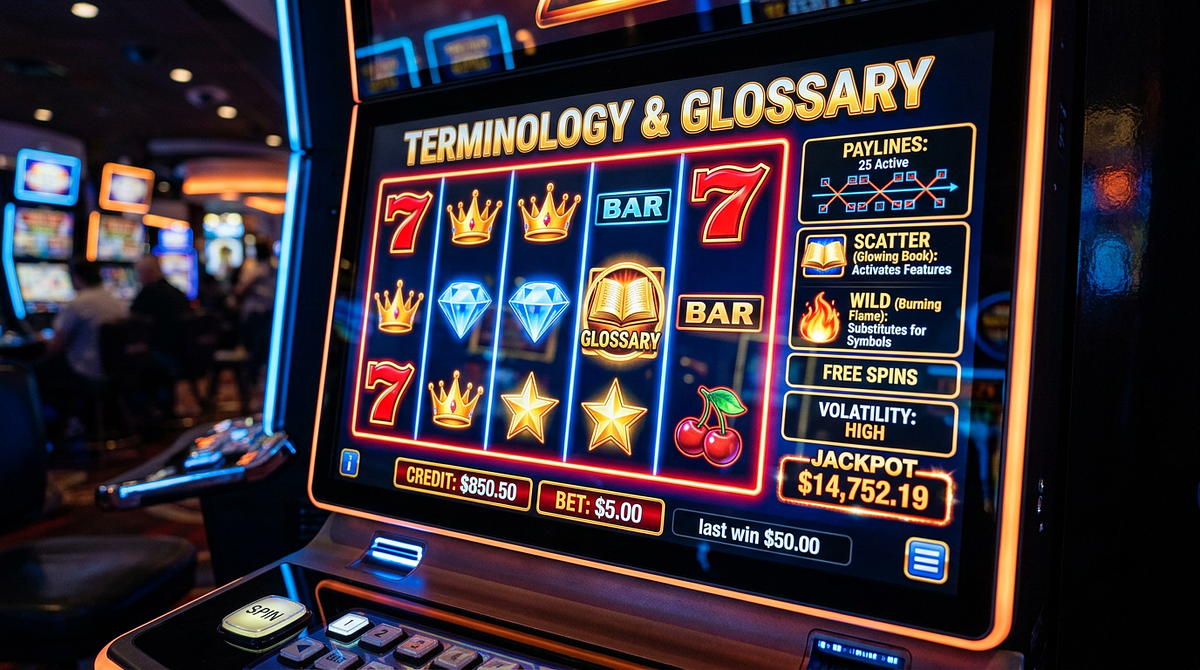
Slot terminology covers the words and phrases used to describe how slot machines work, from basic mechanics to bonus features and payout structures. This glossary defines the key terms you’ll come across in both online and land-based slots, organized alphabetically so you can find what you need quickly. It covers reels, paylines, RTP, volatility, wilds, scatters, multipliers, jackpot types, and wagering concepts. By the end, you’ll have a solid grasp of slot machine language and be able to make better decisions when choosing and playing games.
How This Glossary Is Organized
Entries are arranged alphabetically from A to Z. Each entry gives you the term and a short, factual definition. There’s no ranking or order of importance beyond the alphabet. The vocabulary covers both online slots and physical slot machines you’d find on a casino floor. Some terms only apply to one format — for example, mechanical components that belong to cabinet machines, or software features that only exist in digital games. Others apply to both. Where a term means something different depending on the format, both meanings are covered in the same entry.
Core Slot Mechanics Terms
This category covers the structural and statistical vocabulary that defines how a slot machine works, from the visible layout of reels and symbols to the math that determines outcomes. These terms are the foundation for everything else in this glossary. Bonus features, machine types, and wagering concepts all build on what’s described here.
Reel and Layout Vocabulary
A reel is a vertical column that displays symbols when you spin. On mechanical slots, reels are physical rotating cylinders. On video and online slots, they’re software-rendered columns that simulate the same motion.
A row is a horizontal line of symbol positions across the reels. Most traditional slots use three or four rows, while modern online slots often expand to five, six, or seven.
Symbols are the individual images shown on each reel position. They include standard paying symbols, low-value symbols (often card ranks), and special symbols like wilds and scatters.
A reel strip is the full ordered sequence of symbols assigned to a single reel. On mechanical slots, the strip is a printed band. On online slots, it’s a virtual list the game software references.
A grid is the full matrix of visible symbol positions, typically described as reels by rows — for example, a 5×3 grid.
A ways-to-win configuration replaces fixed paylines with adjacent-reel matching, where any matching symbols on consecutive reels from left to right form a win.
A cluster pays configuration awards wins when a set minimum number of matching symbols touch horizontally or vertically anywhere on the grid, rather than along a line.
Cascading reels, also called tumbling reels, remove winning symbols after a paid combination and drop new symbols into the empty positions. This mechanic shows up mainly on video and online slots, not on traditional mechanical machines.
Statistical and Payout Mechanics
RTP (return to player) is the long-term percentage of total wagered money a slot returns to players over millions of simulated spins. Online slot RTPs commonly fall between 94% and 97%. The figure tells you the theoretical return rate over an extended sample, not what will happen in any single session. For a deeper look at how this number is calculated and where to find it inside a game, see this guide on how to read slot RTP and what the percentage means.
Volatility, also called variance, measures the size and frequency of wins. Low-volatility slots pay smaller wins more often, while high-volatility slots pay larger wins less often. This tells you what kind of win pattern to expect.
Hit frequency is the percentage of spins that produce any win, regardless of size. Typical values range from roughly 20% to 30%. It tells you how often the screen will register a paid result.
House edge is the mathematical advantage held by the operator, expressed as the inverse of RTP. A slot with a 96% RTP carries a 4% house edge, meaning the operator keeps an average of 4% of each wager over the long run.
A random number generator (RNG) is the algorithm that produces the unpredictable numerical outputs used to determine symbol positions on every spin. Certified RNGs are required for licensed online slots and are tested by independent laboratories.
The theoretical payout percentage is the calculated long-term return derived from the game’s paytable and reel composition. It’s mathematically the same as RTP and represents the value certified during regulatory testing, not any short-term outcome.
Payline and Win-Line Vocabulary
The following terms describe how winning combinations are calculated on a slot.
Payline: A defined pattern of symbol positions across the reels on which matching symbols must land to award a payout.
Fixed payline: A payline that’s always active and can’t be turned off. The total bet covers all of them.
Adjustable payline: A payline the player can turn on or off before spinning, which changes the total bet accordingly.
Ways-to-win: A system such as 243 ways or 1,024 ways where any matching symbols on consecutive reels from left to right form a win, regardless of row position.
Variable-reel mechanic: A configuration where the number of symbols per reel changes between spins, producing a different total number of ways-to-win each round.
Pay table: The reference screen that lists symbol values, payline patterns, feature rules, and payout multipliers for the specific slot.
Bonus Feature Terminology
Bonus feature terminology covers the symbols, modifiers, and triggered events that sit on top of the base spinning mechanic. These terms fall into two groups: features that activate within ordinary base-game spins (like special symbols and reel modifiers), and features that need a specific trigger to launch a separate game state (like free spins or pick bonuses). The difference matters because the first type affects individual spins, while the second interrupts standard play entirely.
Special Symbol Vocabulary
A wild is a symbol that substitutes for other symbols on the reels to help complete a winning combination, typically excluding scatter and bonus symbols. Different wild variants change how the wild behaves on the grid.
An expanding wild stretches vertically or horizontally to cover an entire reel or row after landing. A sticky wild stays locked in its position for a set number of subsequent spins instead of disappearing after one. A stacked wild appears as multiple wild symbols arranged in a vertical block on a single reel, so one drop can fill several positions at once. A walking wild, also called a shifting wild, moves one reel position in a set direction on each following spin until it leaves the grid.
A scatter is a symbol that pays or triggers a feature regardless of where it lands on the reels. It doesn’t need to land on an active payline. Scatter wins are typically multiplied by the total stake rather than the line bet.
A bonus symbol is a dedicated trigger symbol whose job is to activate a bonus round or feature when a required number land, separate from any direct payout role. A mystery symbol appears on the reels as an unrevealed placeholder and transforms into a specific paying symbol once all mystery symbols on screen are revealed at the same time. For a full breakdown of how each symbol type functions on the reels, see this guide to slot machine symbols including wilds, scatters, and paylines.
Multiplier and Modifier Vocabulary
A multiplier is a numerical value that increases a payout or another value by a stated factor, such as 2x or 5x. A win multiplier applies the factor to the payline or ways win from a spin, while a total bet multiplier applies the factor to the full stake placed on the spin rather than the line win.
A progressive multiplier is an increasing multiplier whose value rises across consecutive spins or wins according to a defined rule. A fixed multiplier stays at the same value for the duration of the feature.
A global modifier is a feature that changes the reel grid or symbol set before or during a spin. Examples include symbol upgrades, where lower-value symbols are converted into higher-value symbols across the entire grid, and reel modifiers, which add wilds, remove low-paying symbols, expand the grid, or transform full reels into a single symbol type before evaluation.
Triggered Bonus Round Vocabulary
Free spins are a set number of spins awarded without deducting from the player’s balance, typically triggered by landing a defined number of scatter or bonus symbols on a single spin. The base stake from the triggering spin is generally carried into the free spins.
A bonus round is any feature game launched outside normal reel play that follows its own rules and ends with a return to the base game. A pick-and-click bonus presents the player with a set of hidden objects to select, each revealing a prize value, multiplier, or further pick until an end marker is found. A wheel bonus displays a segmented wheel that the player or game spins to award the value or feature shown on the stopping segment.
A hold-and-spin feature, also called a respin feature, locks specific symbols in place and grants a limited number of respins that reset each time a new qualifying symbol lands. A gamble feature offers the player a chance to wager a recent win on a binary or card-based outcome to double or multiply it, with a loss forfeiting the original win.
A buy-bonus, also called feature-buy, lets the player pay a fixed multiple of the stake to enter a bonus round directly without waiting for a natural trigger. For a detailed look at how this option affects RTP and what financial risks it carries, see this page on the bonus buy feature explained including pros, cons, and RTP risks. A retrigger occurs when the trigger condition for a bonus round is met again during that bonus round, adding spins or extending the feature.
Slot Machine Types
Slot machines are classified along three independent lines: physical or visual format, jackpot structure, and gameplay style. A single title can fit into all three at once. A five-reel video slot can also be a wide-area progressive and a branded slot at the same time. The categories below are descriptive labels, not mutually exclusive boxes, and most modern machines combine attributes from all three groupings.
Categorization by Reel and Format
A classic slot, also called a three-reel slot, is defined by three spinning reels and a small symbol set, typically styled with mechanical or mechanical-style visuals and a limited number of paylines. A video slot uses screen-based reel rendering rather than physical reels. The reels are graphical animations driven by a random number generator, which removes the physical constraint on how many symbols can appear per reel.
A five-reel slot has five reel columns, which is the current standard for video slots and the basis for most modern bonus and feature designs. A multi-reel slot is any machine with a reel count outside the three- or five-reel norm, including six-reel and seven-reel layouts.
A 3D slot uses three-dimensional rendered graphics, animated character sequences, and cinematic transitions during base play or bonus rounds. A mobile slot is built or adapted for touchscreen play on smartphones and tablets, with interface elements sized for finger input rather than a mouse or physical buttons.
Categorization by Jackpot Structure
A basic slot, also called a fixed-jackpot slot, pays a top prize set at a fixed multiple of the bet, with no contribution from player wagers to a growing pool. A bonus slot is any machine whose payout structure includes one or more bonus features — free spins, pick rounds, or interactive sub-games — on top of the base paytable. A progressive slot has a jackpot that grows incrementally as wagers are placed, with a fixed percentage of each bet routed to the prize pool until the jackpot is won and resets to a seed value.
Progressive jackpot structures vary in how the prize pool is funded and how widely it’s shared across machines.
Progressive Type
Prize Pool Source
Network Scope
Typical Jackpot Size Range
Standalone progressive
Wagers from a single machine
One physical or virtual machine, isolated
Four to low five figures USD
Local-area progressive
Wagers pooled from machines on one operator’s in-house network
Multiple machines within a single venue or single operator
Five to six figures USD
Wide-area progressive
Wagers pooled from machines across multiple venues or operators linked by a provider network
Multi-venue or multi-operator network spanning jurisdictions
Six to eight figures USD
Categorization by Gameplay Style
A branded slot is built around an intellectual property owned by a third party, such as a film, television series, music act, or sports franchise, under a commercial agreement. A licensed slot is the same thing, with the term putting the emphasis on the licensing arrangement between the game studio and the IP holder.
A themed slot is built around a stylistic concept — ancient Egypt, fruit machines, mythology, horror — without involving a licensed third-party property. A megaways-style variable-reel slot uses a mechanic where the number of symbols on each reel varies between spins, producing a different total number of ways to win on every spin rather than a fixed payline count.
A cluster pays slot awards wins when a minimum number of matching symbols touch horizontally or vertically anywhere on the grid, replacing the payline model entirely. A grid slot uses a symbol grid layout — often square or rectangular at sizes like 6×6 or 7×7 — paired with cascading or cluster mechanics rather than traditional spinning reels.
Wagering and Payout Terms
Slot writing uses two parallel vocabularies for money flow. One belongs to the player at the machine or interface, describing how a wager is built and tracked. The other belongs to the operator and regulator, describing how the machine performs as a revenue unit. Both show up in informational and regulatory sources because the same spin generates data points relevant to each side.
Player-Facing Wagering Vocabulary
Bet is the amount of money committed to a single spin. It’s the sum of all per-line and per-level choices a player has set before pressing spin.
Coin size is the value assigned to each virtual coin used in the wager. Adjusting coin size scales the bet up or down without changing the number of lines played.
Coin denomination is the base monetary unit of the machine, such as $0.01, $0.05, or $1.00. It anchors the conversion between credits shown on screen and actual currency.
Bet level is a multiplier applied on top of the coin size, typically ranging from 1 to 10. Raising the bet level increases the wager per line proportionally.
Max bet is the highest wager the machine accepts on a single spin, while min bet is the lowest. Some jackpots and bonus features require max bet to qualify for the full prize.
Credit is the unit displayed in the machine’s meter, equal to one coin at the selected denomination. Balance is the total monetary value available to the player, usually shown in currency rather than credits.
Line bet is the amount wagered on each active payline. Total stake is the line bet multiplied by the number of active lines and any bet-level multiplier, equaling the full amount risked per spin.
Operator and Accounting Vocabulary
The metrics below describe slot performance from the operator’s perspective and are commonly cited in regulatory reports and industry filings.
Term
What It Measures
Perspective
Typical Context of Use
Coin-in
Total amount wagered across all spins, including replayed winnings
Payout is the amount returned to a player after a winning combination. It can be expressed as a multiplier of the line bet or as a fixed credit value.
Payout percentage, often called return to player or RTP, is the proportion of total wagers a game is programmed to return over a long sample of spins. It’s the player-side equivalent of the operator’s hold.
Hit is any spin that produces a winning combination, regardless of size. How often hits occur is measured by the hit rate or hit frequency.
Near miss describes a spin outcome that looks like a high-value win but falls short, such as two jackpot symbols landing on the payline with the third just above or below.
Big win and mega win are tiered labels for payouts that exceed specific multiples of the total stake, with thresholds set by the game developer. Animations and sound cues typically mark each tier.
Dead spin is a spin that returns no payout. Full pay refers to a paytable variant, mainly in video poker and some classic slots, that offers the highest published return percentage for that game.
A–Z Glossary of Slot Terms
This section pulls all the vocabulary from the earlier thematic sections into one alphabetical reference. Entries appear in A–Z order with a short definition for each. Several terms covered earlier under mechanics, bonus features, machine types, or wagering are restated here so you can look them up directly. Where no standardized vocabulary exists for a letter, that’s noted explicitly.
A
Entries beginning with the letter A.
Action: The total amount wagered across a session or period, regardless of wins or losses. Operators use it as a measure of betting volume rather than profit or loss.
Adjustable payline: A payline configuration that lets the player choose how many of the available lines are active on each spin. Inactive lines don’t pay even if a winning combination appears on them.
All ways: A payout structure where any matching symbols on adjacent reels from left to right form a win, without fixed paylines. Common configurations include 243, 720, and 1,024 ways.
Auto-play: A function that spins the reels automatically for a preset number of rounds at a fixed bet. Players can typically set stop conditions such as a balance threshold or a single-win cap.
B
Balance: The current amount of funds available in the player account or machine credit meter. It goes up with deposits and wins and down with wagers and withdrawals.
Bankroll: The total amount of money a player sets aside for slot play over a defined period. It’s decided before play begins and used to manage session length and bet sizing.
Base game: The standard spinning mode of the slot, outside of any bonus round or free-spin feature. Most spins occur in the base game.
Basic slot: A machine with a single fixed jackpot that doesn’t increase with play. The top prize is paid at a set amount each time it’s hit.
Bet: The amount staked on a single spin. It’s determined by coin size, number of active lines, and any bet multiplier in use.
Bet level: A multiplier applied on top of the coin value to scale the total wager. Higher bet levels increase the stake without changing the coin denomination.
Big win: A payout that exceeds a threshold defined by the game, typically expressed as a multiple of the spin stake. The threshold and animation are set by the game designer.
Bonus: A feature or payout awarded outside the standard reel payouts, often triggered by specific symbol combinations. It can take the form of free spins, a pick game, a wheel, or a credit prize.
Bonus round: A separate game mode entered from the base game when a trigger condition is met. It typically has a different set of rules, symbols, or reel behavior.
Bonus symbol: A dedicated symbol whose appearance, usually in a defined quantity or position, triggers a bonus feature. It’s separate from scatters and wilds.
Branded slot: A slot built around a licensed brand such as a film, TV series, band, or franchise. Theme, audio, and bonus features are designed around the licensed property.
Buy-bonus: A function that lets the player pay a fixed multiple of the current stake to enter the bonus round immediately. The price is typically expressed as a multiplier of the bet, and the feature is restricted or unavailable in some jurisdictions.
C
Cascading reels: A mechanic where winning symbols are removed from the grid and replaced by new symbols falling into the vacated spaces. Each cascade can produce additional wins from the same initial spin.
Cashout: The process of withdrawing the credit balance from a machine or account. On physical machines it typically prints a ticket. Online, it starts a withdrawal request.
Classic slot: A slot styled after early three-reel mechanical machines, usually with a single payline and traditional symbols such as bars, sevens, and fruits. Feature complexity is minimal.
Cluster pays: A payout structure where wins are formed by groups of matching symbols touching horizontally or vertically, rather than along paylines. A minimum cluster size, often five symbols, is required.
Coin denomination: The monetary value assigned to a single coin or credit on the machine. It determines how cash deposits translate into credits.
Coin-in: The total amount of credits wagered on a machine over a defined period. It’s the primary input for calculating hold and theoretical revenue.
Coin-out: The total amount of credits paid out by a machine over a defined period. The difference between coin-in and coin-out represents the machine’s hold.
Coin size: The unit value the player selects to apply per line or per bet level. It’s one of the components used to calculate the total stake per spin.
Credit: A unit of wagering value displayed on the machine balance, equal to one coin at the selected denomination. Credits are converted back to cash on cashout.
D
Dead spin: A spin that produces no winning combination and no feature trigger. The full stake is lost.
Denomination: The monetary value of a single credit on the machine, such as $0.01, $0.25, or $1.00. It determines the cash equivalent of the credit meter.
Drop: The total amount of cash and ticket value inserted into a machine over a defined period. It’s a casino accounting term separate from coin-in.
Double-up: A side feature that lets the player risk a win on a 50/50 outcome, such as a coin flip or high/low card, to double it. Losing the gamble forfeits the original win.
E
Expanding wild: A wild symbol that expands to cover an entire reel or row when it lands. The expanded position substitutes for paying symbols across all affected paylines.
Expanding symbol: A symbol, often used in free-spin features, that grows to fill its entire reel when it appears. It typically pays on all visible positions of the expanded reel.
Expected value: The average return of a wager calculated over the long run, based on the probability and size of each possible outcome. For slots, it’s derived from the game’s payout distribution and house edge.
F
Feature-buy: An option to pay a set multiple of the stake to trigger the bonus feature directly, bypassing the base game. It’s functionally the same as a buy-bonus.
Fixed jackpot: A top prize set at a defined amount that doesn’t change with play. The payout stays the same whenever the winning combination is hit.
Fixed payline: A payline configuration where all available lines are permanently active, with no option to turn them off. The total bet always covers every line.
Free spins: A bonus mode that awards a number of spins at no additional cost, often with modified mechanics such as multipliers, expanded wilds, or different reel sets. The triggering bet typically determines the spin value.
Full pay: A version of a game that uses the highest-paying pay table the manufacturer offers for that title. Operators may deploy lower-paying versions of the same game.
G
Gamble feature: A side game offered after a win that lets the player risk the prize on a binary outcome to multiply it. Losing returns the win to zero.
Grid slot: A slot where symbols land on a square or rectangular grid, typically larger than the standard reel layout, and wins are formed by clusters or ways rather than fixed lines. Cascading mechanics are common in this format.
Ghost symbol: A symbol that disappears from the grid after taking part in a win, often used in cascading or collection mechanics. The vacated cell is then refilled.
H
Handle: The total amount wagered on a machine or across a game over a defined period. It’s synonymous with coin-in in most contexts.
High-volatility slot: A slot whose payout distribution produces infrequent but larger wins. Bankroll swings are wider than on lower-volatility games.
Hit: Any spin that produces a winning combination. It doesn’t mean a net profit on the spin, only that the spin paid something.
Hit frequency: The percentage of spins that result in a hit. It’s reported by the manufacturer and is independent of the size of those wins.
Hold: The percentage of coin-in that the operator retains over time. It’s the operator-side counterpart to the player-side payout percentage.
Hold-and-spin: A feature where specific symbols, often credit-value icons, lock in place while the remaining positions respin a set number of times. Each new matching symbol typically resets the respin counter.
House edge: The mathematical advantage the operator holds over the player, expressed as a percentage of each wager. For slots it’s calculated as 100% minus the RTP.
I
In-game bonus: A feature triggered and resolved within the base game without entering a separate bonus screen. Examples include random wild placements and mid-spin multipliers.
Instant win: A prize awarded immediately on the triggering spin, with no additional player input. It’s usually a fixed credit amount or a multiplier of the stake.