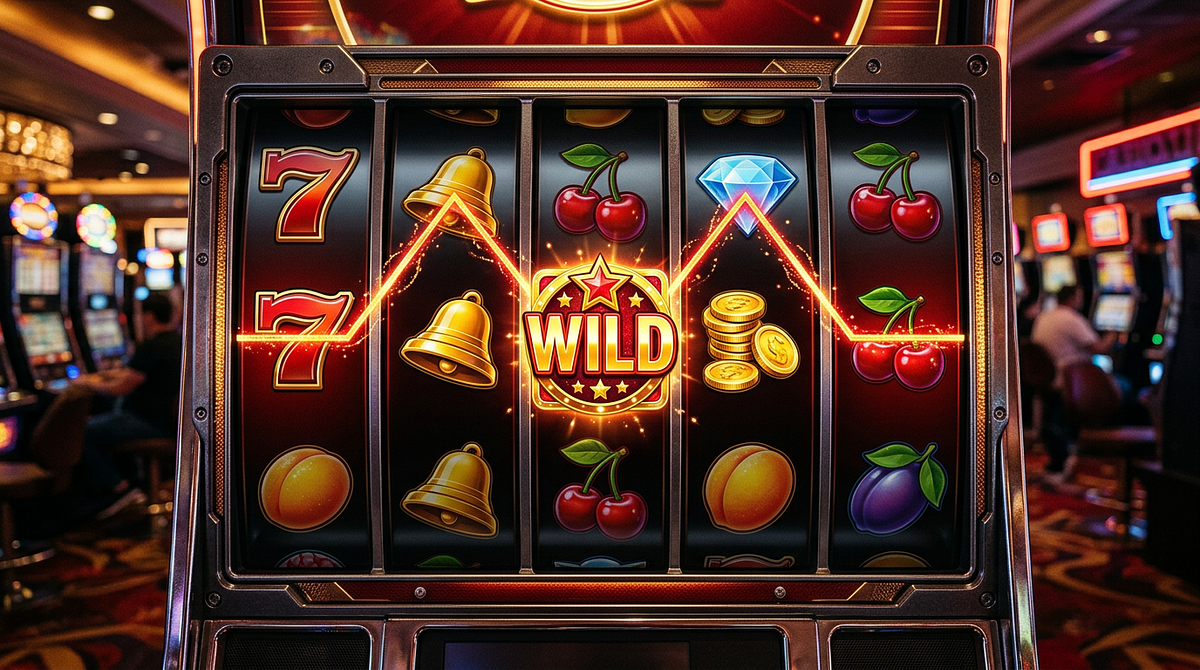
Slot machine symbols decide what happens on every spin. This guide covers the main symbol types you’ll run into: standard symbols, wilds, and scatters. It also explains how paylines and reels work together to produce results. By the end, you’ll know what each symbol does and how to read a spin.
The Reel and Payline Framework
Slot symbols work inside a fixed structure built on two things: reels and paylines. Reels are the vertical columns that show symbols after each spin, arranged in a grid on screen. Paylines are the set paths that cross specific positions on those reels and decide whether a group of symbols counts as a win. You can’t really understand what any symbol does until you understand this grid and the paths that run across it.
How Reels Position Symbols
Each reel is an independent vertical strip that stops after a spin, showing a fixed number of symbol positions on screen. Those positions are arranged in rows, and the number of rows is set by the game. A three-reel game with three rows gives you a 3×3 grid; a five-reel game with three rows gives you a 5×3 grid. Each reel has its own sequence of symbols and stops on its own, so the symbol on one reel has no mechanical connection to the symbol on the reel next to it. The full visible grid, which is the combined result of every reel stopping, is what paylines then scan for matching combinations.
How Paylines Evaluate Winning Combinations
A payline is a defined path that crosses one position on each reel, running left to right across the grid. A winning combination happens when matching symbols land on consecutive reel positions along that path, starting from the leftmost reel and continuing without a gap. If the required symbol isn’t on the first reel the line touches, that line doesn’t pay, no matter what shows up further right. The number of active paylines varies by game, from a single line to dozens or even hundreds running at the same time. Payline shapes also vary: paths can run straight across one row, zig-zag between rows, or follow other fixed patterns defined in the paytable.
Standard Symbols and Their Function
Standard symbols are the base icons that fill the reels and form winning combinations through payline alignment. They make up the majority of what you see on any spin and account for most routine payouts. Unlike special symbols, standard symbols can’t substitute for others and don’t trigger bonus features, free spins, or secondary game modes. Their job is simple: when a set number of identical standard symbols lands on consecutive reels along an active payline, the paytable pays out a corresponding amount. That dependence on payline alignment is what separates standard symbols from wilds and scatters.
Low-Value and High-Value Tiers
Standard symbols are usually split into two tiers based on how much they pay. The low-value tier is typically made up of generic icons, most often playing card ranks like 10, J, Q, K, and A, or simple shapes with no connection to the game’s theme. The high-value tier uses thematic icons built around the game’s visual concept, and these pay significantly more per matching combination than the low-value ones.
Payout size also grows with the length of the matching combination. A three-symbol match pays less than a four-symbol match of the same icon, and a five-symbol match pays the most. The combination of tier (low vs. high) and combination length determines the final payout for any standard-symbol win.
Payout Mechanics for Standard Symbols
A standard symbol’s payout is set entirely by the paytable, which lists the value for every possible matching combination on an active payline. The paytable shows the amount for three, four, and five matching symbols of each icon, with values usually expressed as a multiplier of the line bet or total stake.
Matches must occur on consecutive reels along the payline path, starting from the leftmost reel in most games. Non-adjacent matches don’t count. For example, identical symbols on reels one, two, and four with a different symbol on reel three don’t qualify as a win. The table below shows how low-value and high-value standard symbols compare across the attributes that govern their behavior.
Attribute
Low-Value Standard Symbols
High-Value Standard Symbols
Typical Visual Style
Playing card ranks (10, J, Q, K, A) or generic geometric icons
Thematic icons tied to the game’s visual concept
Relative Payout Size
Smaller payouts per matching combination
Larger payouts per matching combination
Frequency of Appearance
Appear more often on the reels
Appear less often on the reels
Role in Combinations
Generate frequent low-value line wins
Generate less frequent but higher-value line wins
Wild Symbols and Substitution Mechanics
A wild symbol stands in for other symbols on a payline to complete or extend a winning combination. Wilds work with the standard symbol set, replacing whichever missing standard symbol would complete a sequence along an active line. They typically don’t substitute for scatter symbols, bonus symbols, or other feature-triggering symbols, because those follow separate counting rules. The purpose of a wild is to increase how often standard-symbol combinations land and, in some variants, to boost the size of the payout those combinations produce. If you want a broader understanding of how online slots work including RNG and fairness mechanics, that context helps explain why wild substitution is evaluated after the reels stop rather than during the spin.
How Wild Substitution Works on a Payline
Substitution is evaluated after the reels stop. The game reads each active payline from left to right (or both directions, depending on the game) and checks whether the symbols on the reel positions that line crosses form a paying sequence. When a wild sits in one of those positions, it’s treated as whichever standard symbol produces the highest valid combination along that line.
Say a three-reel payline shows symbol A on reel one, a wild on reel two, and symbol A on reel three. The wild is read as a second A, completing a three-of-a-kind combination. But if the line shows A, wild, B, no combination forms, because the wild can’t reconcile two different standard symbols. Scatter and bonus symbols are excluded from this substitution logic and are only counted under their own trigger rules. Wilds also come in several variants, each with different reel behavior.
Stacked Wilds
Stacked wilds are wild symbols that land in two or more adjacent vertical positions on the same reel in a single spin. Instead of one wild appearing in a single cell, the reel strip is set up so a block of wild positions can land within the visible window at once. When a full or partial stack lands, every position it covers on that reel acts as a wild. This raises the chance that wild substitution applies to several paylines at the same time, because each row crossing that reel now contains a wild rather than just one row benefiting from it.
Expanding Wilds
Expanding wilds land in one position on a reel, then expand to fill every visible position on that reel. The expansion happens after landing and before paylines are evaluated, so the entire reel is treated as wild during payout calculation. Every payline that passes through any row of that reel gets a wild in the corresponding position. This turns a single landing into substitution coverage across all active paylines that cross that reel, rather than just one row.
Directional and Other Wild Variants
Directional or walking wilds shift their position by a fixed number of reels on each subsequent spin, moving across the grid over several spins until they exit the visible area. Sticky wilds lock in their landing position for a set number of spins, most often during a free spin feature or bonus round, while the other reels keep spinning around them. Multiplier wilds carry a numeric multiplier value and, when they contribute to a winning combination, multiply that combination’s payout by the stated factor. If two multiplier wilds contribute to the same win, their values are typically combined according to the paytable rules. The table below shows how these variants compare.
Wild Variant
Behavior on Reels
Persistence
Effect on Payouts
Stacked Wild
Occupies multiple adjacent positions on the same reel within a single spin
Lasts only for the spin in which it lands
Increases the number of paylines that receive substitution simultaneously
Expanding Wild
Lands in one position, then expands to cover every position on that reel
Lasts only for the spin in which it lands
Applies wild substitution to all paylines crossing that reel
Walking (Directional) Wild
Shifts a set number of reels per spin until it exits the grid
Persists across multiple consecutive spins
Provides substitution on each spin it remains visible, across different reels
Sticky Wild
Locks in its landing position while other reels continue to spin
Persists for a defined number of spins, usually within a feature
Guarantees wild substitution in the same position on each retained spin
Scatter Symbols and Bonus Triggering
Scatter symbols are special symbols that work independently of payline alignment. Two things define them. First, scatters pay or trigger features based on the total number of scatter symbols appearing anywhere on the visible grid, not on where they land relative to a payline. Second, when a set minimum count of scatters appears on a single spin, they typically kick off a bonus feature like a free spins round. That separation from payline mechanics is what makes scatters their own category and what makes them the primary gateway to bonus features in most slot games.
Why Scatters Operate Independently of Paylines
Scatters are evaluated by counting how many land anywhere on the visible grid after a spin. The game doesn’t check whether those scatters fall on adjacent reels, sit on a specific row, or follow an active payline. This is what separates scatters mechanically from both standard symbols and wilds. Standard symbols only pay when they form a matching sequence along an active payline starting from the leftmost reel, and wild substitution works inside that same payline framework, filling gaps within a sequence. Neither of those mechanisms works outside payline evaluation. Scatters often award a direct payout based on the count itself, and in many games that payout comes on top of triggering a feature. In others, the scatter works purely as a feature trigger with no standalone payout.
Triggering Bonus Rounds and Free Spins
Landing a minimum number of scatters on a single spin, commonly three or more, triggers a bonus feature. The most common type is a free spins round, where you get a set number of spins without wagering extra credits, often with modified reel behavior like added wilds or multipliers. For a full breakdown of how these rounds are structured and what conditions are usually attached, the guide on how free spins work in casino games covers both in-game bonus rounds and promotional spins in detail. Pick-and-click bonuses are another common format, where you choose from a set of hidden objects that reveal credit values or feature awards. Multi-stage bonus games combine sequential rounds, where completing one stage unlocks the next, sometimes with escalating prize pools. The exact count needed to trigger a feature, the number of free spins awarded, and the specific bonus format are all defined in each game’s paytable. These details vary from one slot to another, so it’s worth reading the paytable before you play.
Standard Symbols vs. Special Symbols — Functional Distinctions
The main difference between the two categories comes down to one question: does the symbol depend on payline geometry to produce an outcome, or does it work independently of it? Standard symbols only contribute to payline-based payouts. They must land in a configured position along an active line and form a qualifying combination according to the paytable. Special symbols, wilds and scatters, introduce substitution and triggering mechanics that modify or extend the outcome, either by completing combinations they didn’t literally form or by activating bonus states based on appearance count alone. Understanding this is the foundation for reading any slot game’s paytable. The table below maps each category across five functional dimensions.
Dimension
Standard Symbols
Wild Symbols
Scatter Symbols
Dependence on Paylines
Fully dependent; must land on an active payline
Dependent when paying directly; payline-bound when substituting
Independent; pays regardless of payline position
Substitution Function
None; each symbol represents only itself
Substitutes for most standard symbols to complete combinations
None; does not substitute for other symbols
Triggers Bonus Features
No
Occasionally, depending on game design
Yes; primary trigger for free spins and bonus rounds
Pays on Count Alone
No; requires adjacency on a payline
No; follows payline rules when forming wins
Yes; pays based on total count anywhere on the reels
Typical Visual Differentiation
Theme-based icons such as fruits, letters, or numbers
Labeled “Wild” or marked with a distinct frame or animation
Unique themed icon, often labeled “Scatter” or “Bonus”
Reading a Slot Paytable With Confidence
The split between standard symbols, wilds, and scatters is the key to reading any paytable. Standard symbols pay only when aligned along an active payline, wilds substitute for standard symbols to complete those line combinations, and scatters trigger bonus features regardless of payline position. Before evaluating any game’s outcomes, open its paytable and sort each symbol into one of these three categories.
Frequently Asked Questions
What is a wild symbol in a slot machine?
A wild substitutes for standard symbols to complete combinations along a payline, following the substitution mechanics described earlier. Scatters are excluded from this substitution because they work under a different rule set.
What is a scatter symbol and how does it work?
A scatter pays or triggers a feature based on the total number of scatter symbols appearing anywhere on the grid, not on their alignment along a payline. That grid-count behavior is what makes scatters payline-independent, as covered in the section on bonus triggering above.
What is the difference between a wild and a scatter symbol?
A wild performs substitution to complete payline combinations, while a scatter triggers payouts or features based on its count across the grid. The two symbols have different jobs and aren’t interchangeable.
What are stacked and expanding wilds?
A stacked wild occupies several adjacent positions on a single reel, while an expanding wild grows to cover an entire reel after landing. Both increase the number of wild positions available for substitution, but through different mechanisms.
How do reels and paylines determine a winning combination?
A payline evaluates consecutive matching symbols across adjacent reel positions along a predefined path. A combination is recognized when the required number of matching symbols lands on the reel positions that the payline crosses. Understanding how slot volatility affects how often and how much those combinations pay is the next step once you have the symbol mechanics down.
Do standard symbols trigger bonus rounds?
Standard symbols won’t unlock bonus rounds. That’s the job of scatters or dedicated bonus symbols. Knowing this helps you read a paytable with confidence rather than waiting on wins that simply aren’t coming. If you want to put that knowledge to work, browsing games by their bonus features is a smart place to start.